
Content Writing is one of the most useful skills in today’s digital world. Websites, businesses, blogs, social media platforms, and online stores all need quality content to communicate with their audience.
If you are a beginner and want to learn content writing, you do not need to be an expert writer from the beginning. With regular practice, proper research, basic SEO knowledge, and an understanding of your audience, you can gradually become a better writer.
What Is Content Writing?
Content writing is the process of creating written material for a specific audience and purpose. Content can be created to inform, educate, entertain, engage, or promote a product or service.
Common examples include:
- Blog posts
- Website content
- Articles
- Social media posts
- Product descriptions
- Email newsletters
- Video scripts
- Guides and tutorials
- E-books
Good content should be useful, original, clear, and easy to understand.
Why Is Content Writing Important?

People search online every day for information, products, services, and solutions. Businesses use content to connect with these audiences.
High-quality content can help businesses:
- Attract website visitors
- Build trust and credibility
- Explain products and services
- Improve online visibility
- Increase audience engagement
- Support digital marketing
- Generate potential customers
This is why content writing has become an important part of digital marketing.
Types of Content Writing
There are many different types of content writing. Beginners can explore different formats and later choose an area they enjoy.
Blog Writing
Blog writing involves creating articles around specific topics. Blogs can educate readers, answer questions, provide useful tips, or share information.
A good blog normally has a clear title, introduction, headings, useful information, FAQs, and a conclusion.
Website Content Writing
Website content includes pages such as:
- Home
- About Us
- Services
- Products
- Contact Us
Website content should be clear, concise, and customer-focused so visitors can quickly understand what a business offers.
SEO Content Writing
SEO content writing combines helpful information with search engine optimization techniques.
Important areas include:
- Keywords
- Search intent
- Headings
- Internal links
- Meta title
- Meta description
- Readability
The main goal should always be to create helpful content for readers, while making it easy for search engines to understand.
Social Media Content
Social media writing includes captions, posts, short-form content, and promotional messages.
Social media content should generally be short, engaging, relevant, and easy to understand.
Copywriting
Copywriting is writing designed to encourage a specific action, such as buying a product, signing up for a service, or clicking a button.
Examples include advertisements, landing pages, sales pages, and promotional emails.
Product Description Writing
A product description explains the features, uses, and benefits of a product.
A good description should be accurate, informative, and focused on helping customers understand the product.
Email Writing
Businesses use email writing for newsletters, announcements, promotions, updates, and customer communication.
Effective emails usually have a clear purpose, simple language, and useful information.
Skills Every Content Writer Needs
You do not need to master every skill before starting. However, developing the following skills can help you become a better content writer.
Strong Writing Skills
A good content writer should be able to explain ideas in a simple, clear, and organized way.
Avoid complicated words when simpler words can communicate the same idea.
Research Skills
Good content starts with good research. Before writing, understand the topic and use reliable sources to verify important information.
Grammar and Editing
Basic grammar, spelling, punctuation, and sentence structure are important for professional writing.
Always proofread your content before publishing.
Understanding Your Audience
Before writing, ask yourself:
Who will read this content?
Understanding your audience helps you choose the right tone, vocabulary, examples, and writing style.
Creativity
Creativity helps make content more interesting. You can use examples, practical tips, stories, questions, and different perspectives to make your content more engaging.
Basic SEO Knowledge
Content writers who work with websites can benefit from learning SEO basics such as keywords, search intent, headings, internal linking, and meta information.
How to Write SEO-Friendly Content
SEO-friendly content should be created primarily for people while following basic search optimization practices.
Choose a Relevant Keyword
A keyword is a word or phrase people type into search engines.
For this article, the primary keyword is:
Content Writing
Related keywords may include:
- Content writing for beginners
- Content writer
- Content writing skills
- SEO content writing
- How to become a content writer
- Content writing career
Use keywords naturally rather than repeating them unnecessarily.
Understand Search Intent

Search intent means understanding what a person wants when they search for something.
For example, someone searching for “content writing for beginners” may want to know what content writing is, what skills are required, and how to start.
Your content should answer those questions clearly.
Use Clear Headings
Headings make content easier to scan and understand.
Examples include:
What Is Content Writing?
Types of Content Writing
How to Start Content Writing
Skills Every Content Writer Needs
A clear structure improves the reader experience.
Write for People First

Do not write only to add keywords. Your main goal should be to provide helpful and meaningful information.
Content that genuinely helps readers is more valuable than content filled with unnecessary keywords.
How to Start Content Writing as a Beginner
If you want to start a content writing career, follow these practical steps.
Step 1: Learn the Basics
Learn grammar, sentence structure, research, article formatting, headings, and different content formats.
Step 2: Choose Topics to Practice
Start writing about topics you understand or enjoy, such as:
- Lifestyle
- Technology
- Education
- Business
- Digital marketing
- Travel
- Personal development
Step 3: Practice Regularly
Practice is one of the most important parts of becoming a better writer.
Write blog posts, articles, captions, or product descriptions regularly.
Step 4: Create a Portfolio
A writing portfolio is a collection of your best writing samples.
You can include:
- Blog articles
- SEO articles
- Website content
- Product descriptions
- Social media posts
Even without professional experience, you can create sample articles to demonstrate your skills.
Step 5: Learn Basic SEO
Learn about keywords, search intent, headings, internal links, meta titles, meta descriptions, and readability.
SEO knowledge can make your writing more useful for websites and digital marketing teams.
Step 6: Find Writing Opportunities
Once you have writing samples, explore internships, entry-level jobs, freelance projects, and content-related roles.
A good portfolio can help demonstrate your abilities to employers and clients.
Common Content Writing Mistakes
Beginners often make mistakes while learning. Here are some common ones to avoid.
Writing Without Research: Always understand the topic before writing.
Keyword Stuffing: Avoid repeating keywords unnaturally.
Long Sentences: Keep sentences clear and easy to read.
Poor Structure: Use headings, short paragraphs, and bullet points where appropriate.
Ignoring the Audience: Always write according to your readers’ needs.
Copying Content: Research the topic but write in your own words.
Skipping Editing: Always proofread before publishing.
Tools That Can Help Content Writers

Digital tools can make the writing process easier.
Useful tool categories include:
- Grammar checkers
- Keyword research tools
- Trend research tools
- Document editors
- Note-taking tools
- Plagiarism checkers
- Analytics tools
- AI writing assistants
Tools should support your work, but you should always review, fact-check, and edit the final content yourself.
How to Improve Your Content Writing Skills
Becoming a better writer takes time and regular practice.
Read regularly: Reading quality content can improve your vocabulary and writing style.
Write consistently: Regular writing helps you become more confident.
Study good articles: Observe how professional writers use introductions, headings, examples, and conclusions.
Edit your work: Remove unnecessary words and improve unclear sentences.
Learn from feedback: Constructive feedback can help you identify areas for improvement.
Keep learning SEO: Digital marketing and search practices continue to evolve.
Content Writing Career Opportunities

Content writing can lead to several career paths, including:
- Content Writer
- SEO Content Writer
- Blog Writer
- Copywriter
- Content Editor
- Content Strategist
- Social Media Writer
- Technical Writer
- Freelance Writer
With experience, writers can specialize in a particular industry or move into content marketing and strategy.
Content Writing vs Copywriting
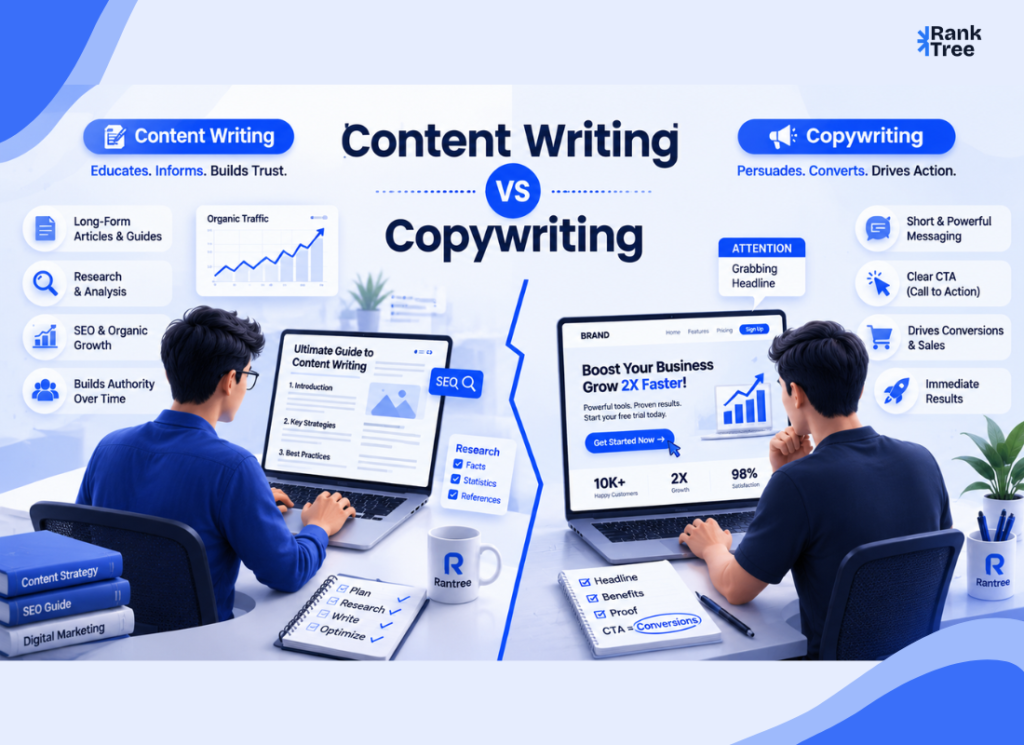
These two terms are related but have different primary purposes.
Content writing generally focuses on informing, educating, or engaging an audience.
Copywriting generally focuses on persuading readers to take a specific action.
For example, a detailed educational blog can be content writing, while an advertisement designed to encourage a purchase can be copywriting.
Future of Content Writing
The content industry continues to change as businesses adopt new digital platforms and AI tools.
AI can assist with brainstorming, research organization, outlines, and other tasks. However, human skills such as creativity, original thinking, fact-checking, editing, and understanding the audience remain important.
Writers who learn to use technology responsibly while developing strong writing skills can adapt to changes in the industry.
FAQ’s.
. What is content writing?
Content writing is the process of creating written material for websites, blogs, social media, businesses, and other digital platforms. The goal is usually to inform, educate, engage, or persuade readers.
2. How can a beginner start content writing?
Start by learning the basics of writing, grammar, research, SEO, and audience understanding. Then practice by writing blog posts, articles, social media captions, or sample website content and build a small portfolio.
3. What skills are needed for content writing?
Important skills include clear communication, research, creativity, grammar, storytelling, SEO knowledge, editing, and understanding your target audience. You don’t need to master everything at once.
4. Is content writing a good career for beginners?
Yes. Content writing can be a good starting point for people who enjoy writing, researching, and learning about different topics. With regular practice, you can develop your skills and explore different types of writing work.
5. What are the different types of content writing?
Common types include blog writing, SEO writing, website content, social media content, email writing, product descriptions, copywriting, technical writing, and script writing.